Discoveries
A ‘Garde Perlée’ Sabre
by Marc Marbot
In a series of short articles, I intend to present several examples of sabres used during the Batavian Republic (Commonwealth), the Kingdom of Holland and, more generally, the period of French rule. It is not my intention to burden the reader with excessive detail, nor to provoke a discussion as to precisely which French-influenced sabres were or were not used in the Netherlands during this turbulent period. Without direct evidence, this is often difficult to establish.
The sabres discussed here do, however, have some connection with the Dutch army of the period. I am well aware that, particularly within the collecting community, newly proposed additions to the established record are often viewed with some scepticism. Yet the available literature remains limited. The 1981 work by J.P. Puype, former chief curator of, among others, the Dutch Army Museum, is still regarded as a leading reference on Dutch edged weapons. I therefore wish to draw attention to several sabres not described in that work which are nevertheless worthy of consideration.
My intention is not to provide a complete overview. J.P. Puype’s chronological survey, together with the model designations established by him, already covers the subject extensively. I nevertheless hope that readers will enjoy seeing a number of fine examples presented here.
Officer’s models are particularly fascinating, as such weapons were often privately purchased. This also makes them more difficult to classify precisely. Depending upon his regiment and personal means, an officer could choose from a considerable variety of sabres and makers.
It has become clear that Solingen played a central role as a supplier and producer of blades. A substantial proportion of the officer’s sabre blades from this period originated there. With that said, I shall turn to the subject itself: the weapons.

View All Images
Batavian Republic Light Cavalry Officer’s Sabre
“Garde Perlée”, Model c.1790–1810
For this first article I would like to introduce a sabre which, like so many weapons from this period, displays unmistakable French influence. This type of sabre was also used by officers during the Batavian Republic. It is characteristic of the light cavalry and was probably used until the end of French rule.
The hilt has its origins in the final quarter of the eighteenth century. The beaded knuckle guard, or garde perlée, was popular among officers serving under Louis XVI. Its appearance reflected the Rococo fashion of the period and the influence of Marie Antoinette, particularly the popularity of strings of pearls and flowing decorative lines.
The origins of this type of sabre lie in Hungary, and in France the style was referred to as à la Hongroise — “in the Hungarian manner”. I have deliberately retained the French term Garde Perlée, as it has become a universally recognised term among collectors for this particular type of hilt and sabre.
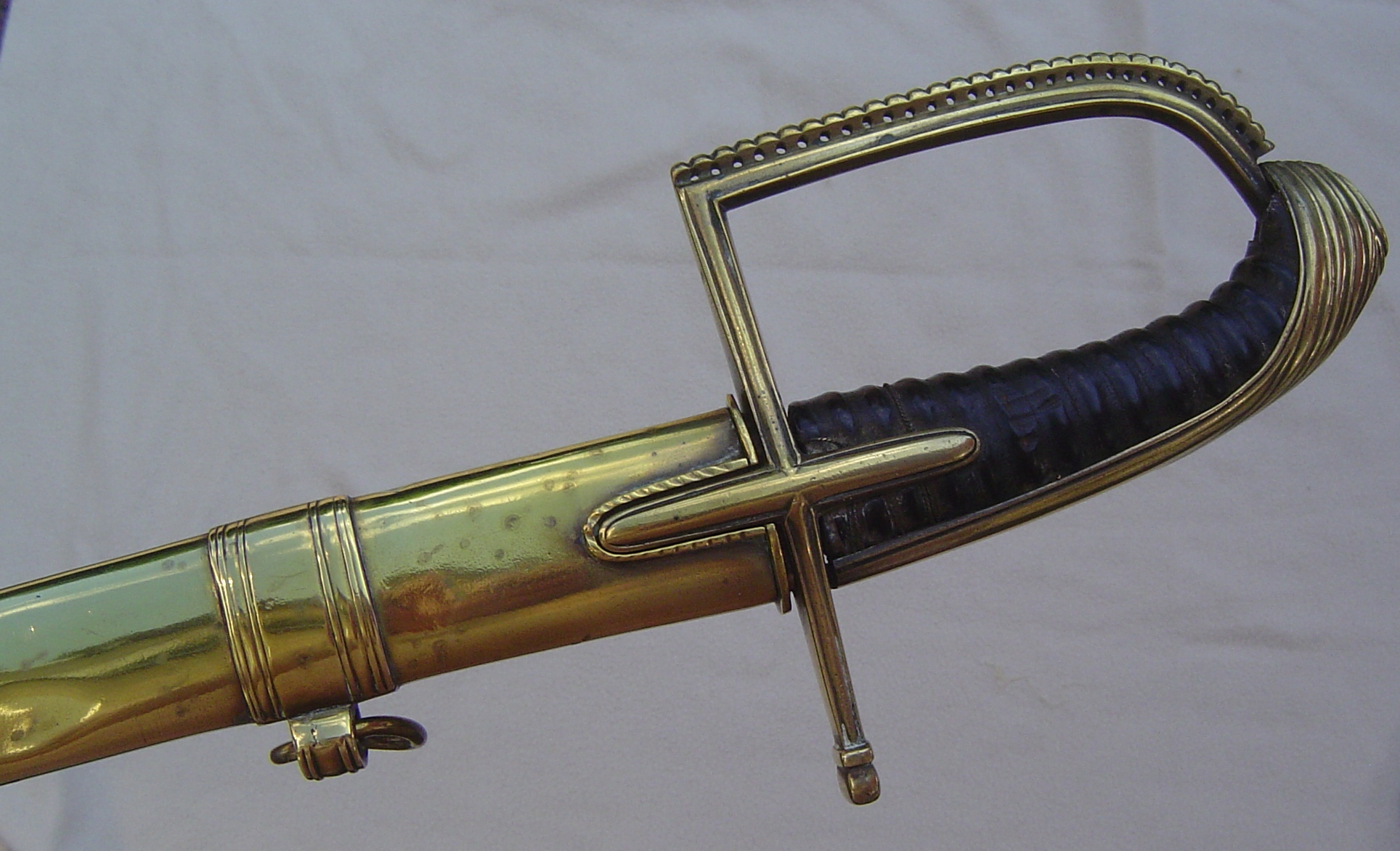
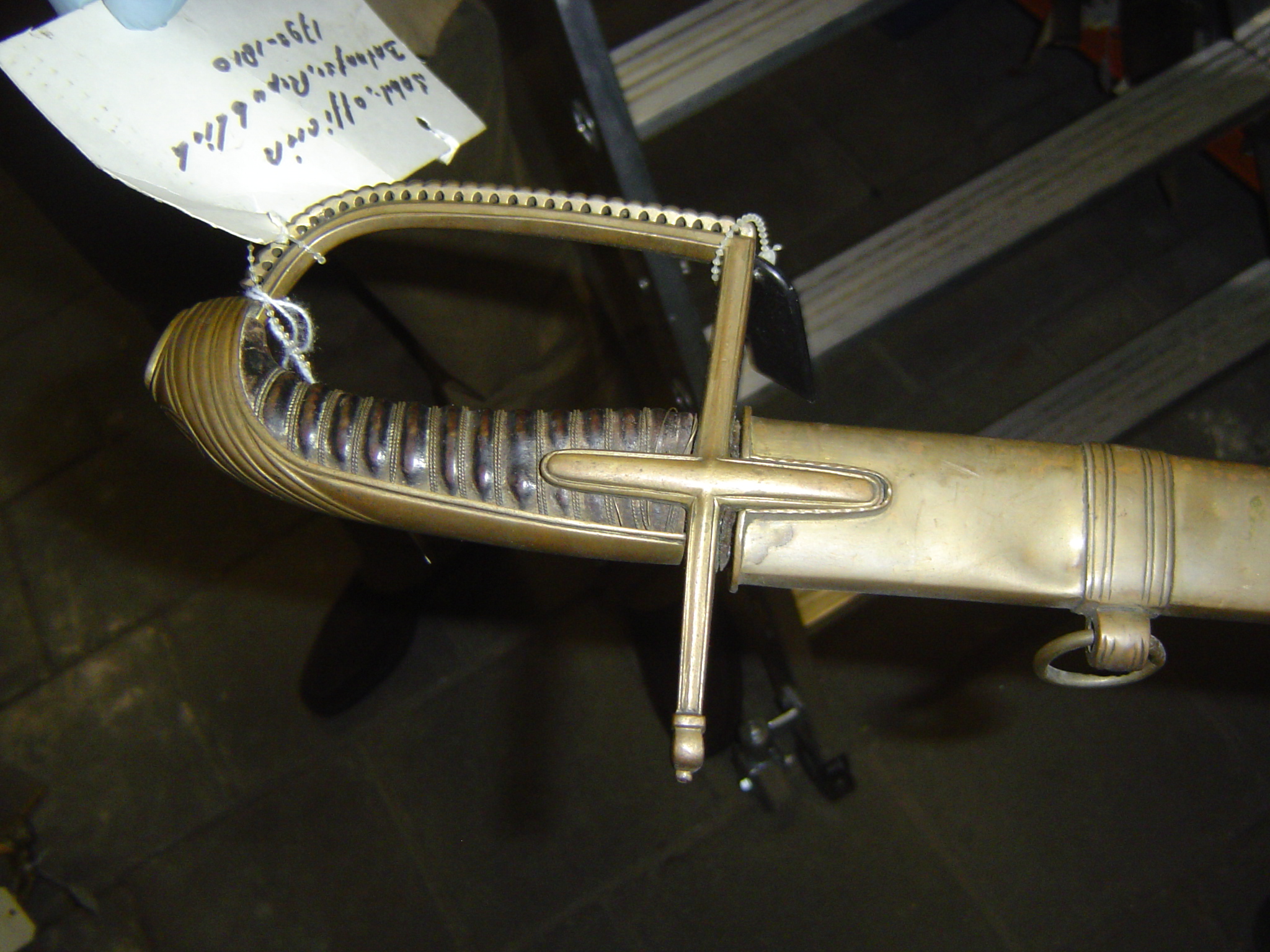
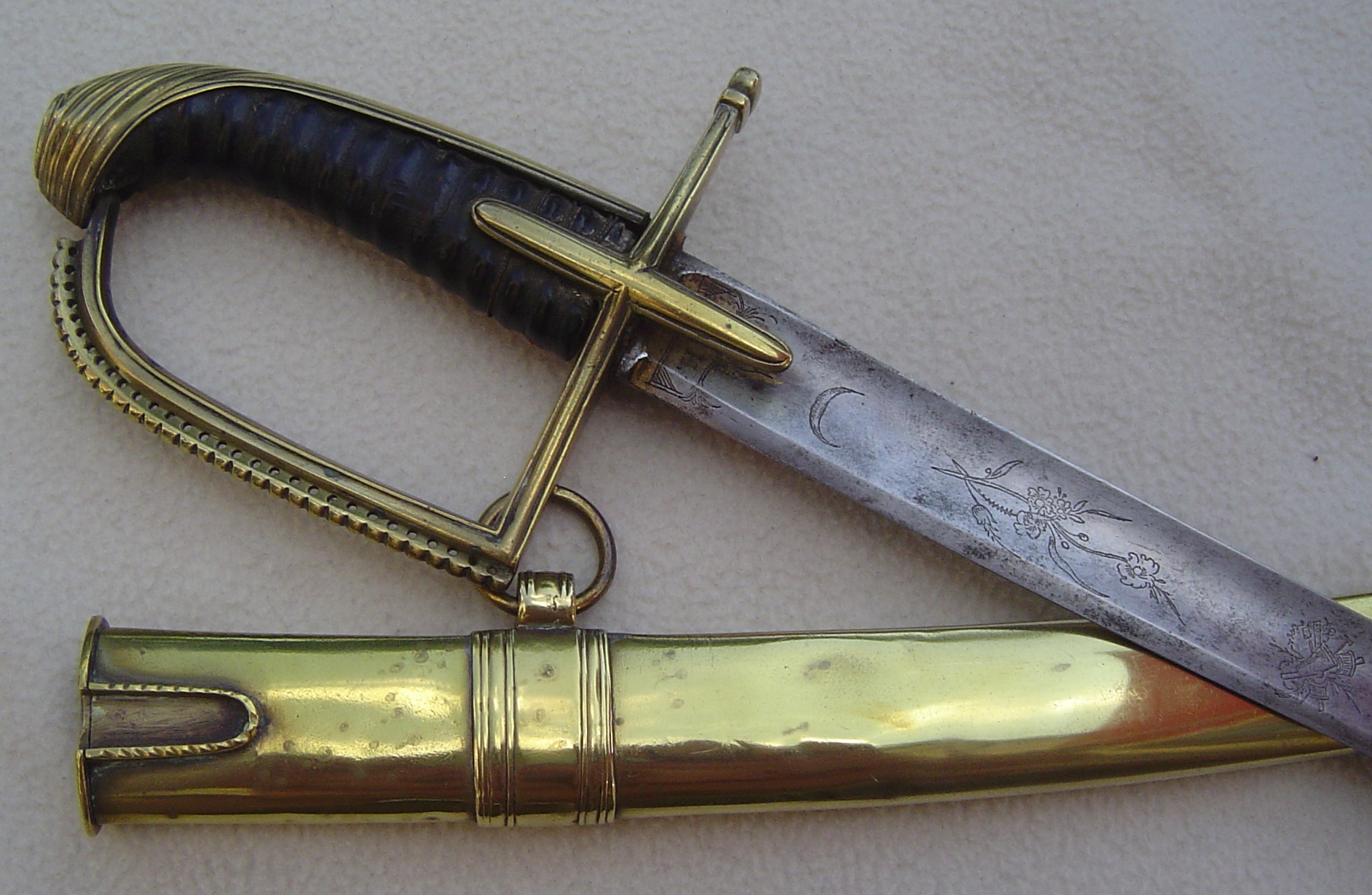
The sabre is fitted with a brass knuckle guard and a long backpiece. The beaded knuckle guard passes beneath the backpiece, which terminates in the pommel and is decorated with linear ornament. The guard incorporates two side bars which, when the sabre is inserted into its brass scabbard, pass down on either side of the grip into the mouth of the scabbard, thereby preventing movement of the sabre within it.
The wooden grip is covered in leather and was originally bound with double-twisted wire, accompanied by a single smooth wire along the upper and lower edges. Portions of this original wire binding remain on the present example (see photograph 1).
A symbol on the back of the blade indicates that it originated from a Solingen workshop. At the ricasso it is marked with the letters “S H”, representing Samuel Henckels (1765–1800). The blade is further engraved with, among other motifs, floral ornament and trophies. Traces remain of a blued ground and gilding within and around the engraved decoration. The cutting edge of the blade also bears evidence of combat use.
The scabbard is made of brass and fitted with two brass bands carrying the suspension rings. Internally, it is lined with a soft wood, probably limewood, both to protect the blade and to hold it securely in place. At the lower end of the scabbard is an iron drag which shows signs of wear.
Dimensions
| Measurement | Dimension |
|---|---|
| Overall length of sabre in scabbard | 990 mm |
| Length of hilt | 133 mm |
| Blade length | 820 mm |
| Blade width at ricasso | 30 mm |
| Width of scabbard bands | 27 mm |
| Distance between scabbard bands | 220 mm |
| Length of quillons | 72 mm |
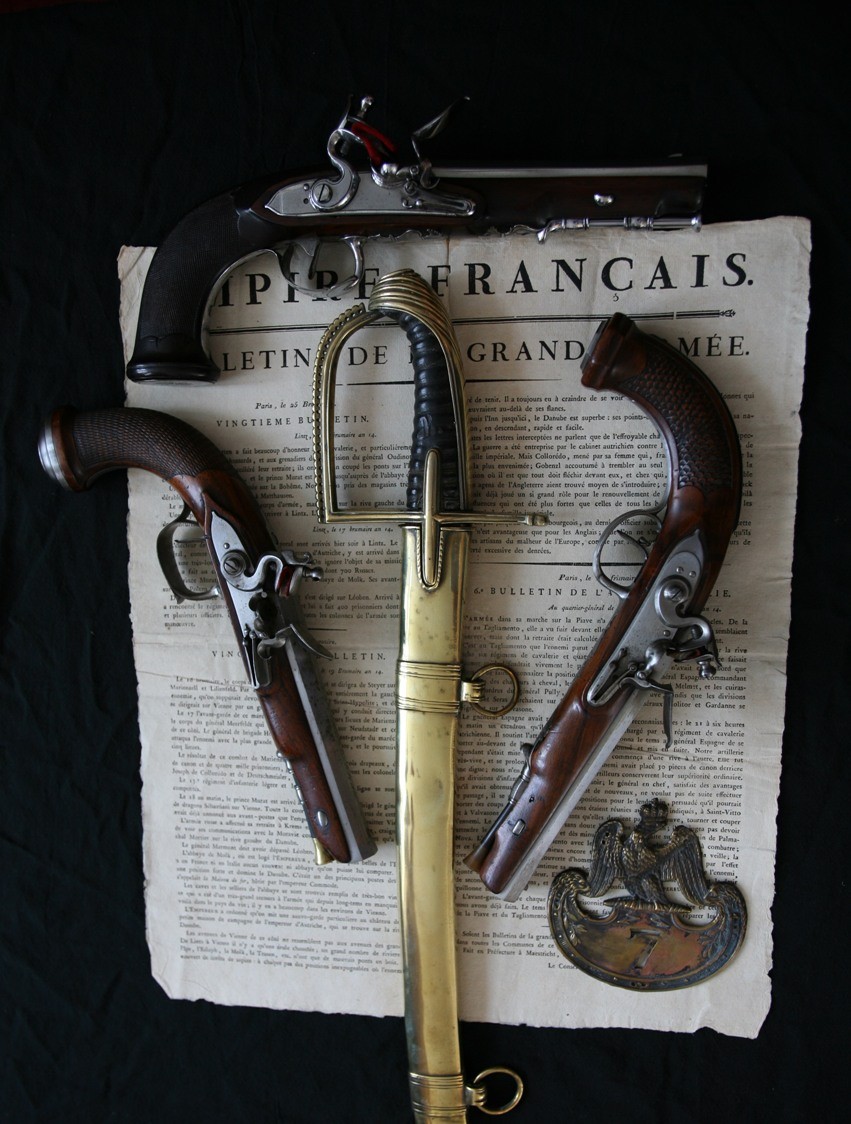
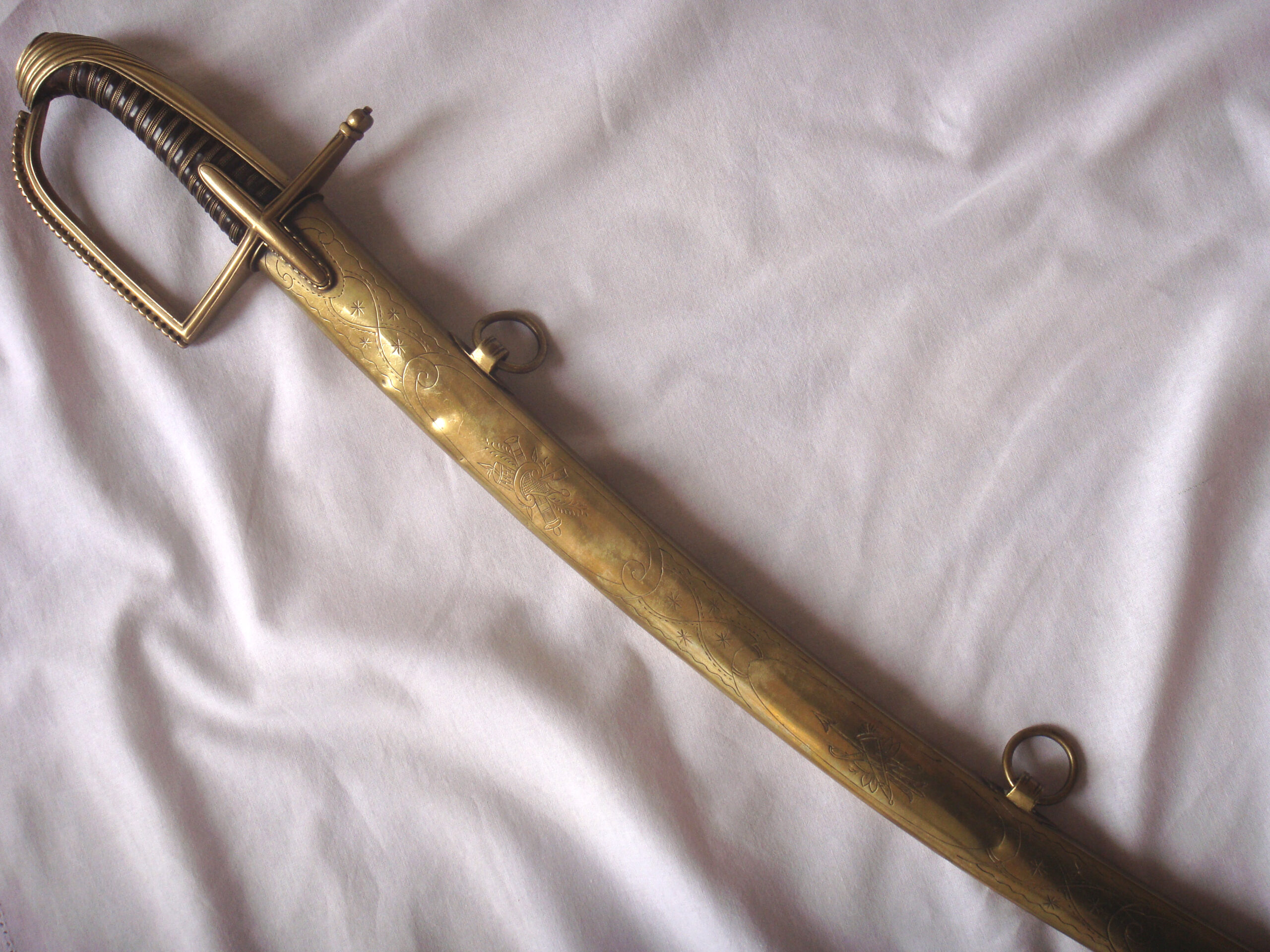
Finally, several further examples of sabres fitted with this type of hilt are illustrated. Photograph 4 shows exactly the same model as an example held in the reserve collection of the Dutch Army Museum. That sabre has been attributed to a Batavian officer. Photograph 5 shows a more luxurious version of the same model.
Its scabbard is finely decorated with various engraved motifs. It is known that a small number of examples with engraved scabbards were also acquired by the Garde d’Honneur, or Guard of Honour, of the city of Antwerp, a unit specifically raised for Napoleon’s visit to the city.
Notes
- J.P. Puype, Blanke Wapens, Nederlandse slag- en steekwapens sinds 1600.
- Very early examples of this type of sabre are already recorded in France under Louis XV as the modèle à la hongroise – garde perlée. See Christian Blondieau, Sabres Français 1680–1814, p. 93.
- According to N.J.A.H. Van Es, “it was strictly forbidden to allow sabres to drag”; see p. 6 of De Resolutiën van Koning Lodewijk Napoleon betreffende het wapen der rijdende artillerie.
A few tiny parts of the bibliography on page 2 are too soft in the photograph for me to reproduce bibliographically letter-perfect, but the actual article body, dimensions and notes are readable. For the Red Lancer Bulletin, I would use the English version above with only a very light editorial pass and retain Marc Marbot as the credited author/source rather than presenting it as newly authored Red Lancer text.