Discoveries
Sabre of an Officer of the Hussars of the Batavian Republic
by Marc Marbot
A brief historical background
At the end of 1794 and beginning of 1795, around the establishment of the Batavian Republic, the army of the former Republic of the United Netherlands comprised the following cavalry regiments:
7 Cavalry regiments
1 Regiment of Guard Dragoons
1 Regiment of Horse Guards
1 Squadron of the Garde du Corps
2 Dragoon regiments
2 Hussar regiments
The Guard regiments were disbanded, while the seven Cavalry regiments, considerably weakened by the preceding campaigns, were amalgamated into two formations, designated the 1st and 2nd Cavalry Regiments. The two Dragoon regiments were combined to form the Dragoon Regiment, while the two Hussar regiments, Van Heeckeren and Timmerman, were similarly amalgamated under the designation Hussar Regiment.
This organisation remained unchanged until 1803. On 23 October of that year, the two Cavalry regiments were redesignated the 1st and 2nd Light Dragoon Regiments. The existing Dragoon Regiment was subsequently given the designation of the Line.
On 11 June 1805, however, the 2nd Light Dragoon Regiment was disbanded and amalgamated with the 1st Light Dragoon Regiment under the designation 2nd Dragoon Regiment. The Dragoon Regiment of the Line now became the 1st Regiment. The Hussar Regiment remained unchanged throughout the period of the Batavian Republic.
View All Images
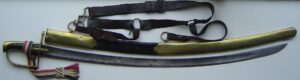
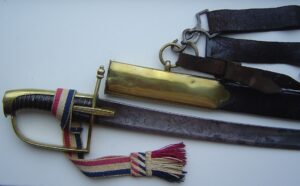
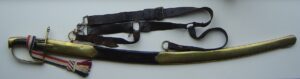


 The sabre examined in this article is an example used by an officer of the Batavian Hussars, or possibly the Light Dragoons.
Returning to the sabre
Sabres of this type are briefly mentioned in Jan Piet Puype’s book (2), and also in Armamentaria No. 23, published by the Dutch Army Museum, on page 83. The present sabre corresponds closely with the Light Dragoon officer’s sabre illustrated there.
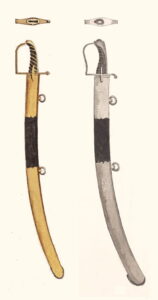
Jan Piet Puype describes sabres dating from the period 1795–1800 and attributes this type to the Light Dragoons. The Batavian Light Dragoon regiments existed only briefly, as outlined above, and were armed with sabres of the type used by the Hussars, or light cavalry. The officer’s sabre discussed here displays characteristics of both types, as can be seen in Figure 1.
Nevertheless, I consider it to be a Hussar officer’s sabre, particularly in view of the relatively short existence of the two Light Dragoon regiments. Furthermore, I have so far found no evidence that officers of the Light Dragoons carried a different type of sabre from officers of the Hussars.
F.G. de Wilde writes that when the Cavalry regiments were converted into Light Dragoons, the sergeants and trumpeters were issued with a sabre having a brass hilt without a guard plate and a brass scabbard. Officers received a similar sabre, but with a hilt and black leather scabbard with metal mounts (see Armamentaria No. 10, p. 51).
In the same publication, De Wilde also refers to a series of watercolours depicting Hussar sabres (see note 2). It cannot be ruled out that this pattern of sabre had already been in use among Dutch light cavalry officers at an earlier date, particularly considering the date at which the French pattern from which it was derived — the sabre modèle M.1767 — entered service with the French Army (3).
In the Netherlands, the type subsequently became known as a ‘Batavian’ model, and was probably carried on during the Kingdom of Holland (1806–1810), including by officers of the 2nd or 3rd Hussar Regiment.
During my research into this sabre, I encountered an identical example in the reserve collection of the Dutch Army Museum, together with several variations of the same model, including one fitted with an entirely brass scabbard. J.P. Puype attributes the latter type to non-commissioned officers of the Light Dragoons, as can also be seen in Armamentaria No. 23.
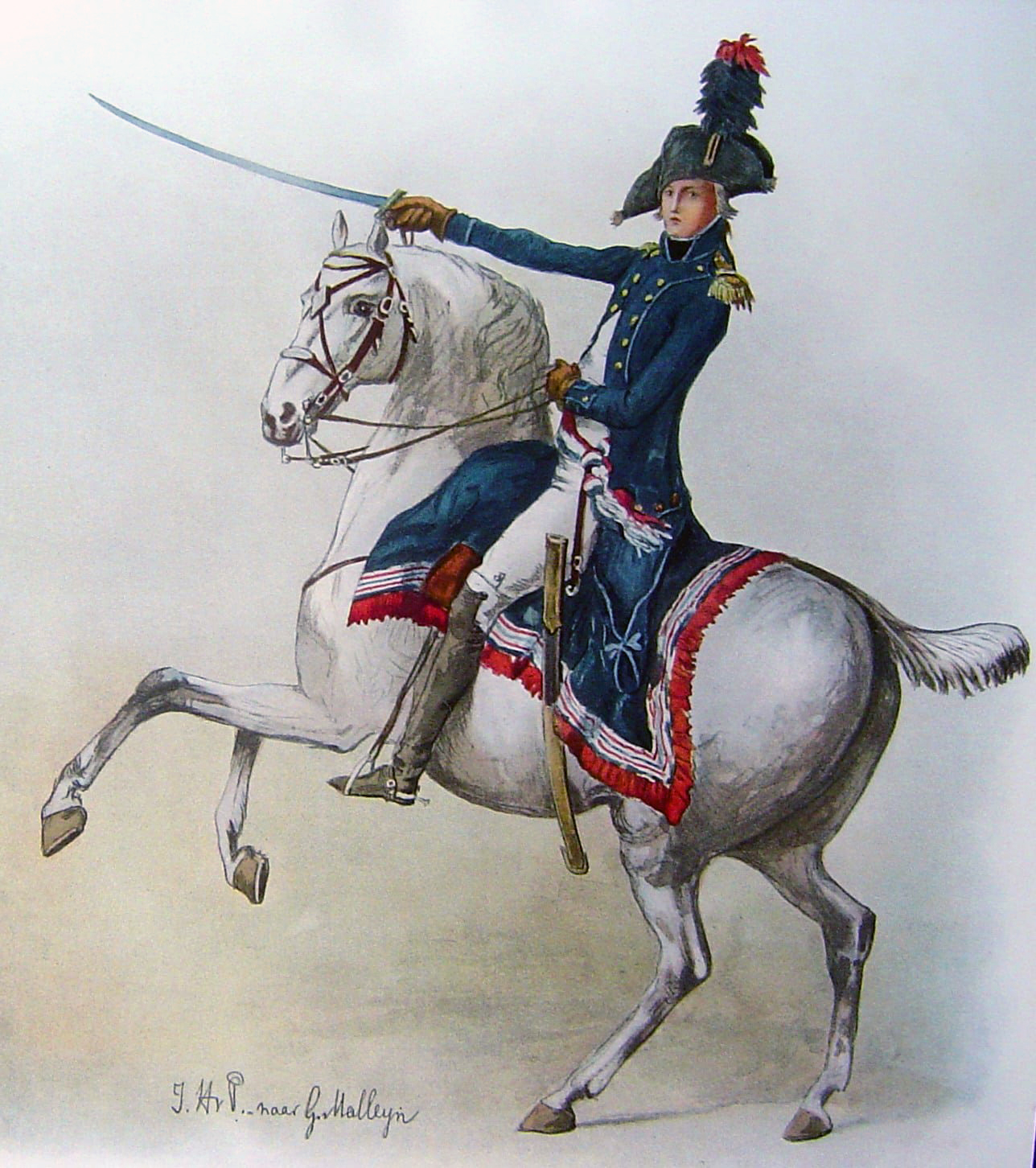
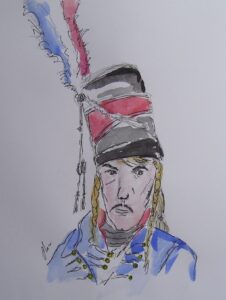
The presence of several examples in the Army Museum with hilts of this form may indicate that the pattern was relatively widespread. Evidence also suggests that distinctions were not always as rigid as written regulations might imply. A painting by the renowned artist J. Hoynck van Papendrecht provides one such example. The painting, dating from 1801, depicts Michel Marinus de Monchehy, colonel of the Rotterdam armed civic guard, carrying a sabre of this same general type (Figure 2). Could the mounted civic guard also have had access to this pattern of sabre?
The sabre
The sabre is fitted with a brass knuckle-bow and backpiece. The side bars of the guard are decorated with two vertical lines. The wooden grip is covered in leather and bound with plain copper wire.
The blade, originating from a Solingen workshop, is single-edged and engraved over approximately one third of its length with various decorative elements, including floral motifs (4). Traces remain indicating that the blade was originally blued and gilt.
The scabbard is made of leather and fitted with two long brass mounts at either end. The lower scabbard mount is fitted with an iron drag. On the suspension side, the edges of the brass scabbard mounts are chased for decoration.
Sabres were generally worn on the left, and it is therefore common to find engraving or other decorative work confined to the outward-facing side. The suspension rings attached to the scabbard mounts are likewise made of brass.
This particular example also retains its original suspension strap, of the type normally associated with these sabres (5). The tricolour sabre knot is of a pattern used during the Batavian period.
Dimensions
| Grip length | 122 mm |
| Knuckle-bow length | 110 mm |
| Maximum blade width at the ricasso | 35 mm |
| Side-bar length | 50 mm |
| Blade length | 810 mm |
| Lower scabbard mount | 481 mm |
| Upper scabbard mount | 167 mm |
| Overall length of sabre | 932 mm |
Sources
- J.P. Puype — Blanke Wapens, Nederlandse slag- en steekwapens sinds 1600 (1981)
- J.P. Puype — Armamentaria No. 23 (1988), ‘Revolutionaire gevesten’, pp. 76–91
- J.P. Puype & Piet De Gryse — Viertalig lexicon van de gevestwapens (2006)
- F.G. De Wilde — Armamentaria No. 10 (1975), ‘De Uniformen van de Bataafse republiek, de cavalerie’, pp. 41–56
- Dr F.G. De Wilde — De uniformen van het Nederlandse leger ten tijde van de Bataafse Republiek en het Koninkrijk Holland 1795–1810
- F.J.G. Ten Raa — De Uniformen van de Nederlandse Zee- en Landmacht hier te lande en in de Koloniën (1900)
- Michel Pétard — Les sabres des Hussards, Histoire des sabres de hussards de Louis XIV à nos jours (2010)
- Michel Pétard — Des sabres et des épées, Vol. I (1999)
- Tiziano Tonelli — Vivat Hussard, la Lame degli ussari. Dal XVII secolo alla fine dell’Impero Napoleonico (2010)
- Christian Ariès — Armes Blanches Militaires Françaises
Figures 1 & 2: collection of the Dutch Army Museum, Delft. Figure 3: drawn by the author.
Notes
1) “You should see our Hussars at the ball; they waltz like devils and do not turn about like the Dragoons.”
This is a line from a popular satirical song sung by French Hussars during the Napoleonic period. The Hussars regarded themselves as superior to the Dragoons — mounted infantrymen. Following the Battle of Austerlitz in 1805, where the Dragoons had clearly demonstrated their worth, such mockery diminished.
In France, light cavalry comprised the regiments of Hussars, Chasseurs à Cheval and Lancers. Heavy cavalry was intended for massed attacks and represented the army’s principal shock force. Light cavalry was employed for reconnaissance, service with the advance and rear guards, outpost duty, protection of the flanks, pursuit and maintaining communications.
The Dragoons had originally been mounted infantry, effectively providing rapidly deployable firepower. In time, they developed into fully fledged cavalry. Interestingly, within the Dutch Army a distinction existed within the light cavalry itself between Hussars and Light Dragoons.
2) J.P. Puype, Blanke Wapens, Nederlandse slag- en steekwapens sinds 1600, De Tijdstroom, Lochem-Poperinge, 1981, p. 66.
The illustrations belong to a series of anonymous watercolours in the collection of the Army Museum in Delft, entitled Wapens uit den tijd der Bataafsche Republiek en Koning Louis [Weapons from the Period of the Batavian Republic and King Louis]. Following, amongst other things, handwriting research by Mr Puype, it became apparent that this title had at some point been written on the portfolio in which the watercolours were kept at the Army Museum. The images themselves are considered to reflect arms being carried during the period concerned.
3) According to Christian Ariès, 3/1970:
“Montures à fer à calotte & branche simple: officiers de la cavalerie légère 1793–1810 + Vlg 20/197 Montures à calotte à une branche: sabres de hussards modèle 1767 du Régiment Colonel-Général et divers”
See also Michel Pétard, Des sabres et des épées, Vol. I, p. 76.
4) The back of the blade bears a symbol associated with a Solingen workshop. There are no maker’s initials on the ricasso, unlike the example discussed in my previous article in Wapenfeiten No. 3-2010. That blade bore the initials S.H., which I attributed to Samuel Henckels. This possible maker is discussed in Richard Bezdek’s German Swords & Sword Makers. It cannot, however, be excluded that the initials represented another maker or supplier.
5) See Dr F.G. De Wilde, De uniformen van het Nederlandse leger ten tijde van de Bataafse Republiek en het Koninkrijk Holland 1795–1810, p. 61.