Discoveries
Sabres of the etat-major officers from the Batave Republique
by Marc Marbot
The sabre models discussed in this article are several officers’ sabres used by higher-ranking officers during the Batavian period and which were probably carried throughout the French period.
I should begin by noting that it is extremely difficult to establish that a particular model of sabre was used exclusively by the Batavian army and was originally manufactured within the territory of the Batavian Republic. The French army exercised a dominant influence on, among other things, armament during this turbulent period and largely set the standard.
There are, however, a number of similarities and characteristic features which become apparent when examples known from Dutch museums and private collections are compared. These same characteristics can also be seen in the relatively scarce surviving drawings and paintings depicting sabres of this type.
This article presents several such examples, together with some of the documentary material known from the Batavian period.
The scope of this article is too limited to provide a complete survey of my findings concerning all surviving examples, and I have therefore restricted myself to those which stand out most clearly. I shall, however, broadly describe the general characteristics shared by many sabres from this period.
One factor that may make the explanation somewhat confusing is the political situation in both the Netherlands and France. Since this article deals with “Batavian” sabres, I shall at times refer specifically to this period of Dutch history. However, French political developments had such a profound influence on what is known in the Netherlands as the “French Period” that it is impossible not to use the successive French political regimes as chronological reference points.
Still with me…?

View All Images
Illustrations
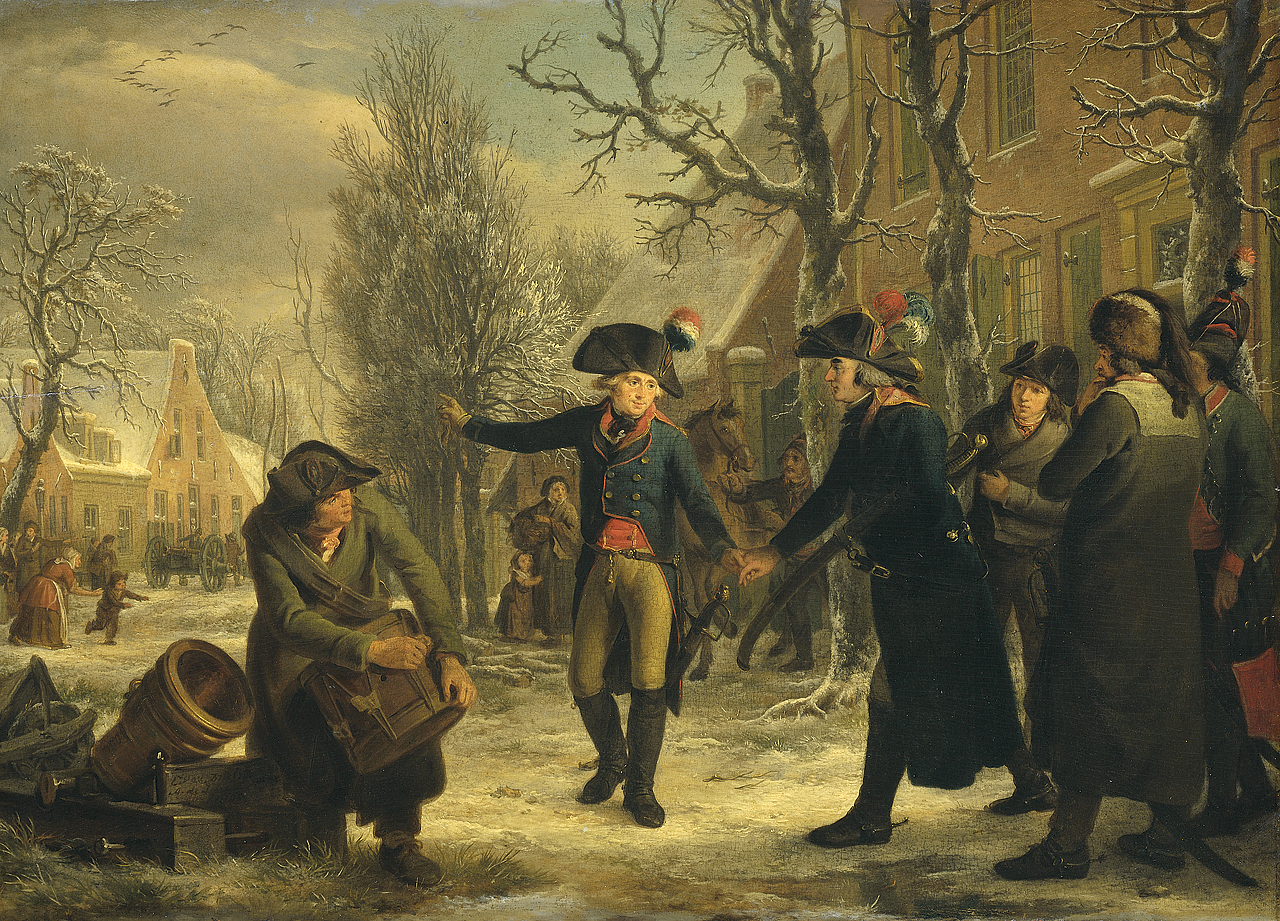
An important historical source is the painting by Adriaan de Lelie, in which General Daendels takes leave of Lieutenant-Colonel Krayenhoff before the latter departs on a mission to Amsterdam in 1795 (fig. 1).
The painting clearly reveals several interesting details of the sabres worn by Daendels and Krayenhoff.
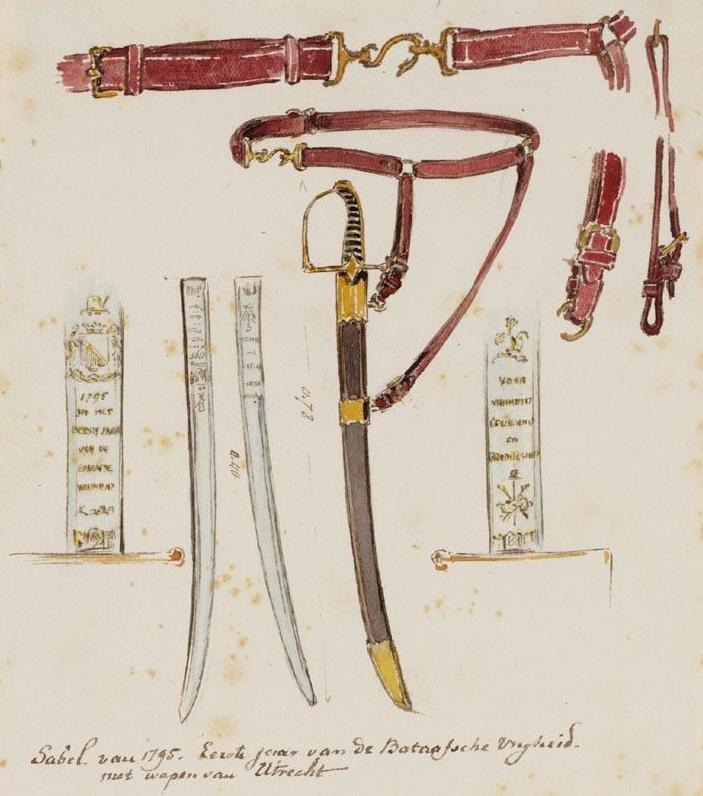
There is also a print by an unknown artist in the archives of the Army Museum, dated “1795”, which clearly depicts a sabre carried by an officer during the Batavian Republic. The sabre shown in this print bears a strong resemblance to the sabre carried by General Daendels which is held in the permanent collection of the Voerman Museum in Hattem (see figs. 2, 3 and 5).
In the book by F.G. De Wilde, we also find a number of illustrations in which several general identifying features can be recognised. Unfortunately, these images are insufficiently detailed to allow closer analysis.
In private collections I have encountered a number of sabres displaying the same identifying features. Finally, the Army Museum in Delft holds a group of sabres which s
how the same similarities with the documentary sources and characteristics mentioned above. Sabels opperofficieren Bataafse…

Characteristics of the Sabres
Apart from the choice of materials, one of the most noticeable features is the relationship between length and width, together with the more moderate curvature when compared with models from later periods.
Leather scabbards fitted with brass or copper mounts were used much more frequently. By comparison, during the height of the Napoleonic period — the French Empire — complete brass scabbards became considerably more common, including on sabres for senior officers.
The use of pure copper is also characteristic of the period preceding Napoleonic rule. Examples include sabres fitted with hilts and scabbard mounts made of red copper. This was probably related to the availability of materials and the disruption of production during the early years of the Revolution.
As already mentioned, blades from this earlier period were often less curved, somewhat broader and proportionally shorter than later Napoleonic models carried by officers and senior officers.
A Montmorency-style fuller — a narrow, long fuller running close to the back of the blade — is also encountered relatively frequently.
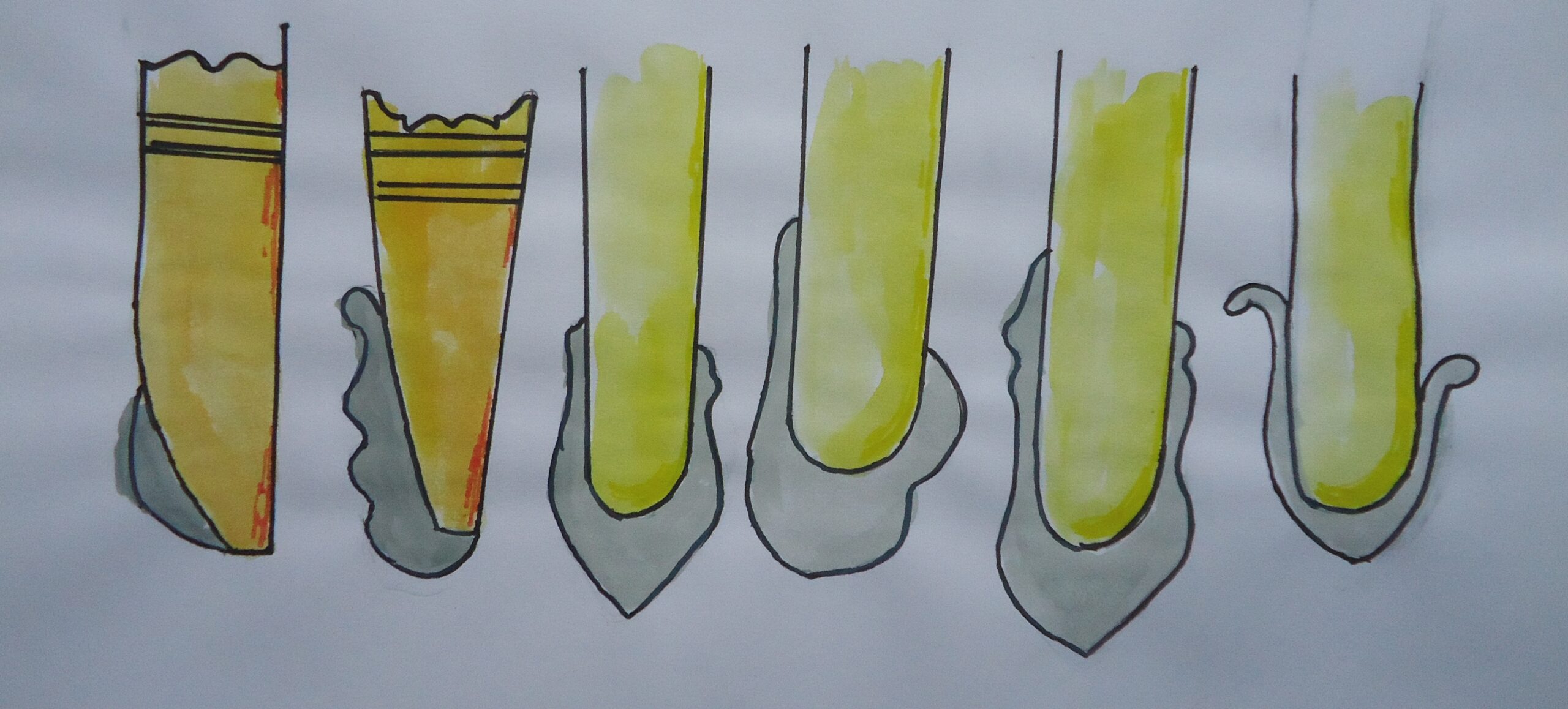
The scabbard drags often have a somewhat different form. Figure 6 illustrates this. Examples 1 and 2 show types of drag particularly associated with Batavian sabres, while nos. 3 to 5 are more typical of sabres from the later Imperial period — broadly corresponding in Holland to the period from Schimmelpenninck through to the Kingdom of Holland.
Example 6 shows a type of drag encountered on hussar sabres dating from the final period of the Ancien Régime, immediately before the French Revolution. I shall return to a particularly interesting sabre from that period in a future article.
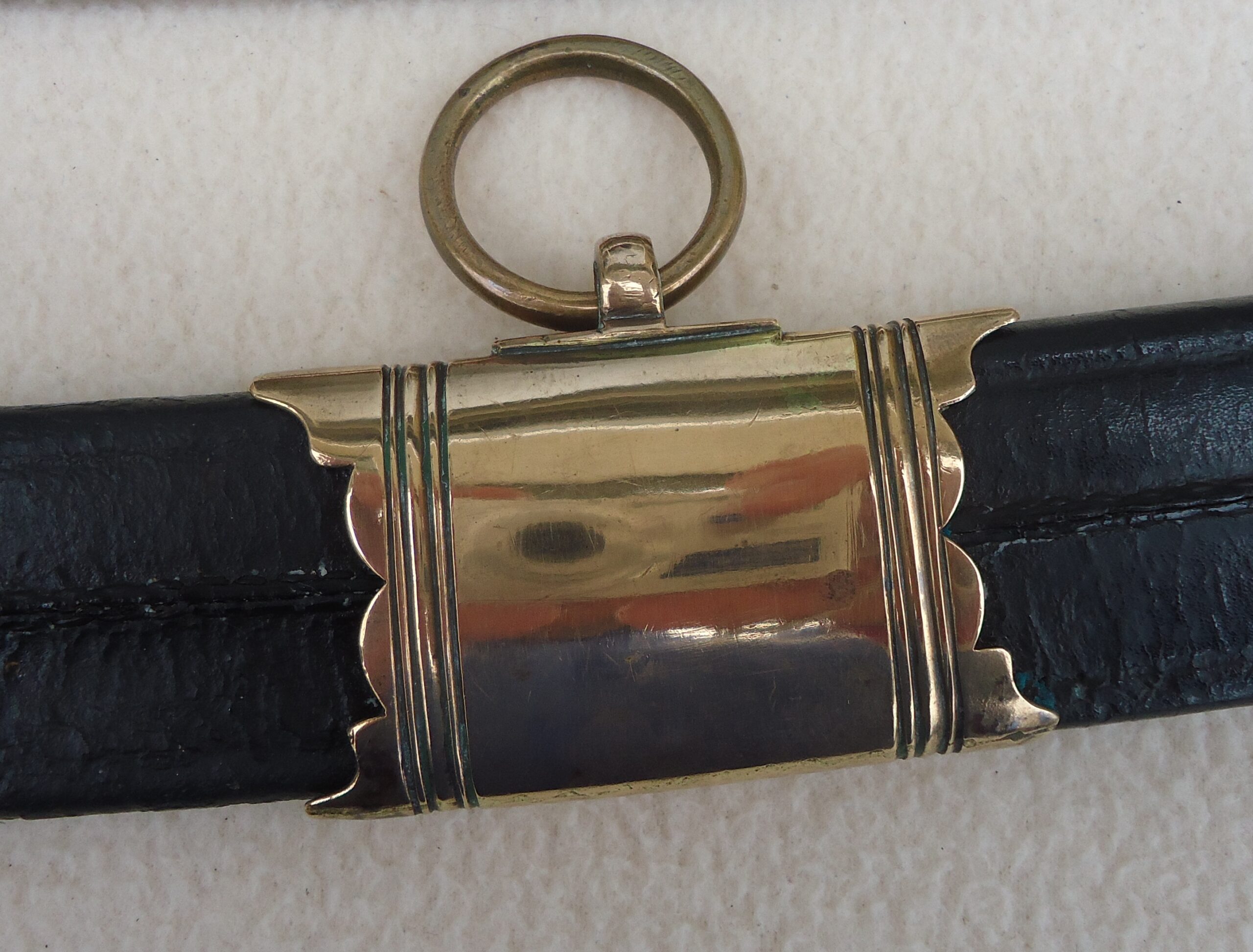
The suspension loops to which the carrying rings are attached are also generally thinner, more simply finished and sometimes flatter in form than those encountered on sabres from the Napoleonic Wars. Later examples frequently have a more olive-shaped form and are decorated with lines or moulded borders.
Naturally, transitional combinations and cross-influences are also encountered (see fig. 7).
Another striking feature is that during the early Batavian Republic — corresponding broadly with the Revolutionary and Directory periods — officers’ sabres could have relatively elaborate decoration on the hilt while the scabbard remained comparatively plain.
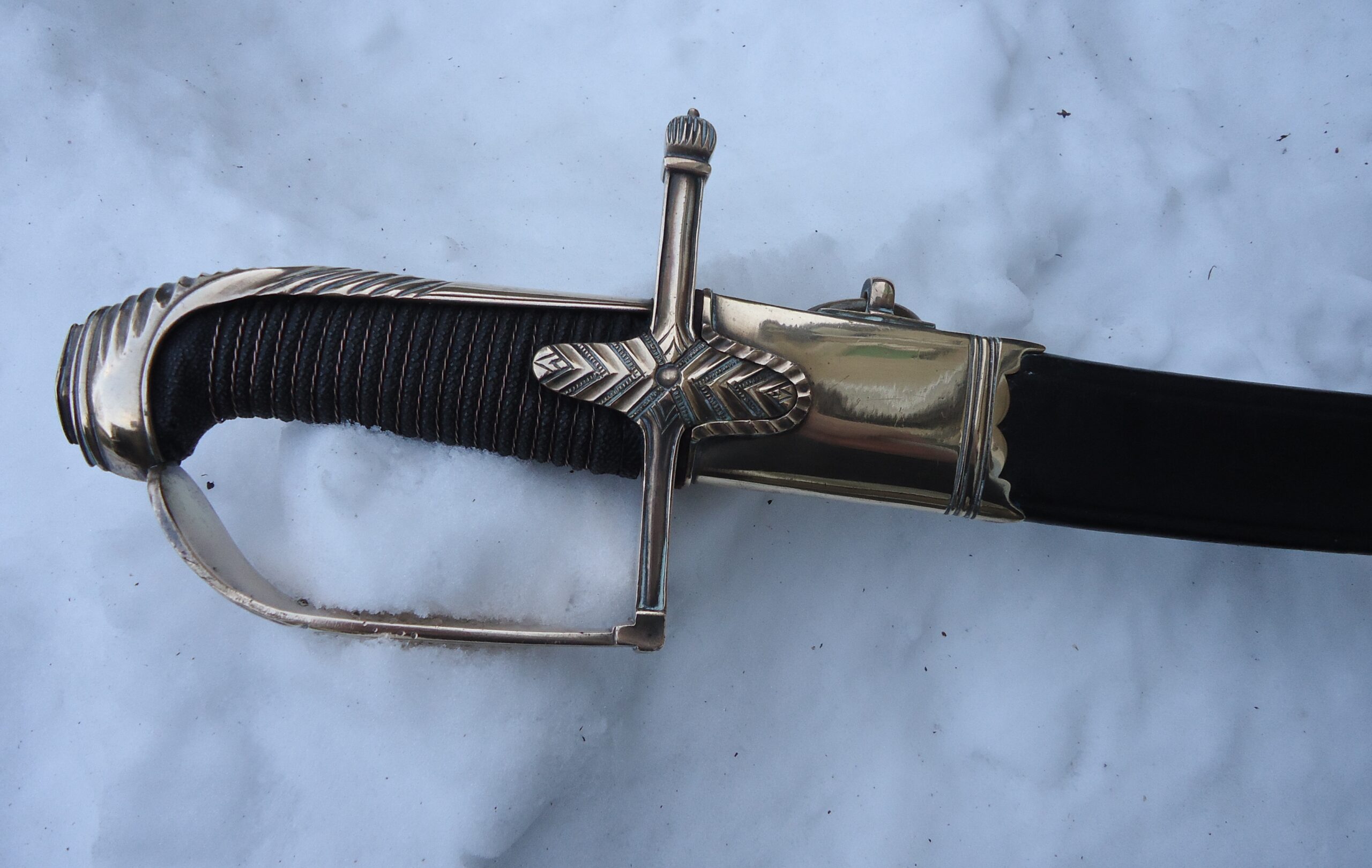
A particularly characteristic feature of hilts from this period is the screwed knuckle-bow. Rather than being secured by means of an extension fitted into or beneath the pommel, the upper end of the knuckle-bow was attached to the backstrap or pommel with a small screw.
A helmet-shaped pommel was another design commonly encountered during the period preceding the Consulate (1799–1803) (see also fig. 7). Sabels opperofficieren Bataafse…
Another factor contributing to the gradual change in design was the introduction of standardised weapon models within the French army, particularly for enlisted men, during the early Empire.
Officers were still largely free to choose their own weapons, but increasing numbers of senior officers’ sabres were produced in the general style of regulation troopers’ models, although executed in a more luxurious form. Well-known examples include the An XI and An XIII patterns.
Generals and staff officers were also assigned a prescribed model, the famous sabre which became known as the Vendémiaire An XII, Sabre de Généraux.
Naturally, many privately commissioned non-regulation models continued to be used, but an attempt was nevertheless being made to move towards greater standardisation.
A similar development can be seen among Napoleon’s Imperial Guard Chasseurs à Cheval, for whom a standard officer’s sabre was introduced.
The most significant stylistic transformation of the French period occurred during the transition from the Directory to the Consulate.
Napoleon now appeared prominently on the political stage as one of the three Consuls and subsequently became First Consul for life. This so-called Consular period exerted a considerable influence on fashion, uniforms and weapon design.
The often rather austere sabres of the preceding period were succeeded by weapons which were generally more elegant, lighter and longer, with greater use of classical forms and decorative motifs.
The choice of materials also changed. Whereas wooden grips covered with leather, with or without wire binding, had previously been common, woods such as carved ebony were increasingly used as grip material.
Blade decoration also changed. Patriotic symbols and slogans gradually gave way to more floral and general decorative motifs.
This fascinating and highly creative period was in turn followed by the Empire style, which became somewhat more restrained, with stronger geometric lines.
The temporary Peace of Amiens contributed to a flourishing of contemporary fashion, while Napoleon’s campaign in Egypt also had a distinct influence on everyday decorative taste. Sabels opperofficieren Bataafse…
The Sabres
The Daendels Sabre
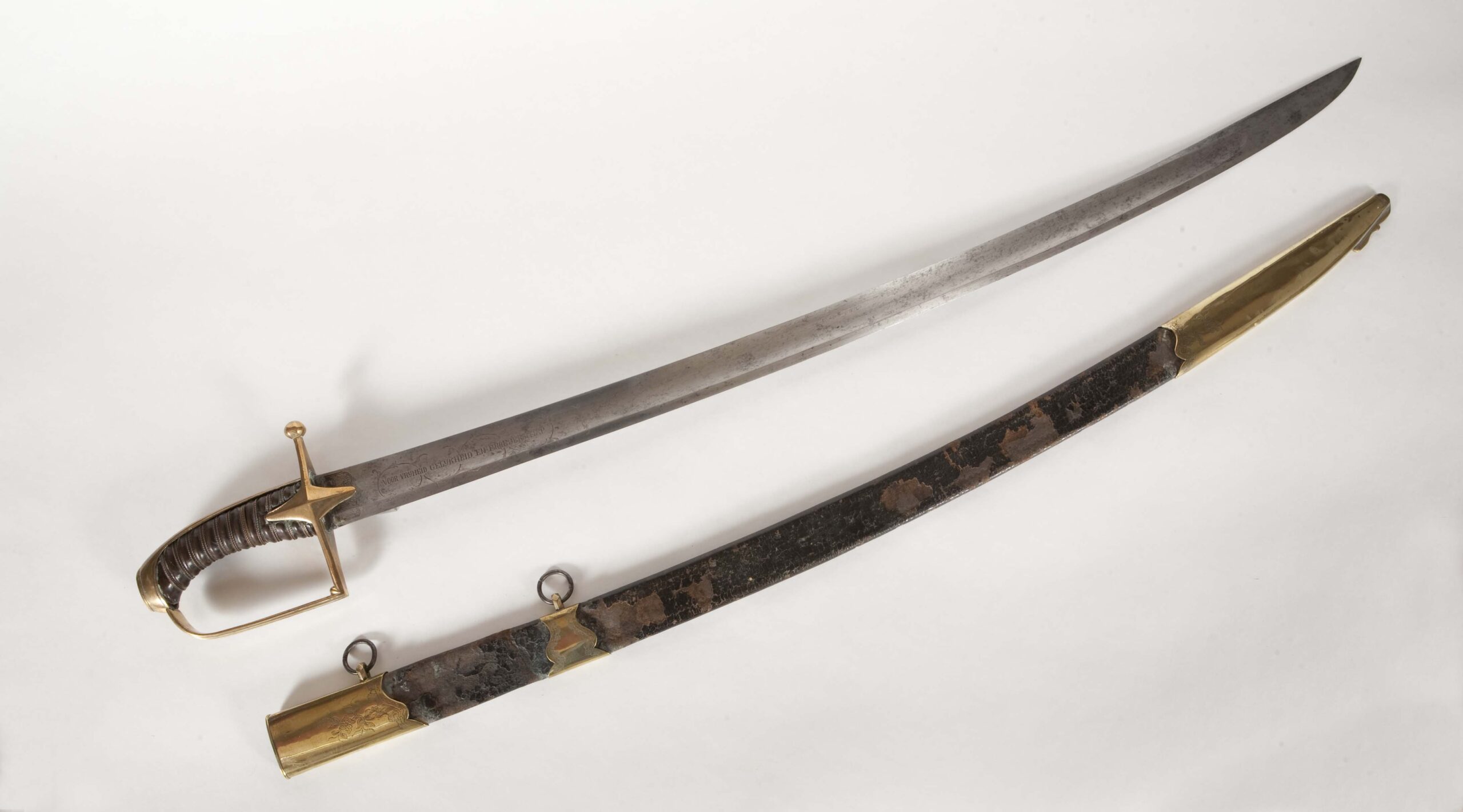
The sabre carried by Herman Willem Daendels is a fine classical example from this period. The weapon displays clear characteristics of the early French Revolutionary era (figs. 3–5).
It was probably the sabre carried by the Patriot Daendels during the first phase of his career as commanding officer of the Batavian Legion, which had been attached to the Army of the North under General Pichegru when it invaded the Netherlands in 1794.
The curvature of the 84 cm blade is less pronounced than that usually encountered on later models and on weapons used by cavalry units.
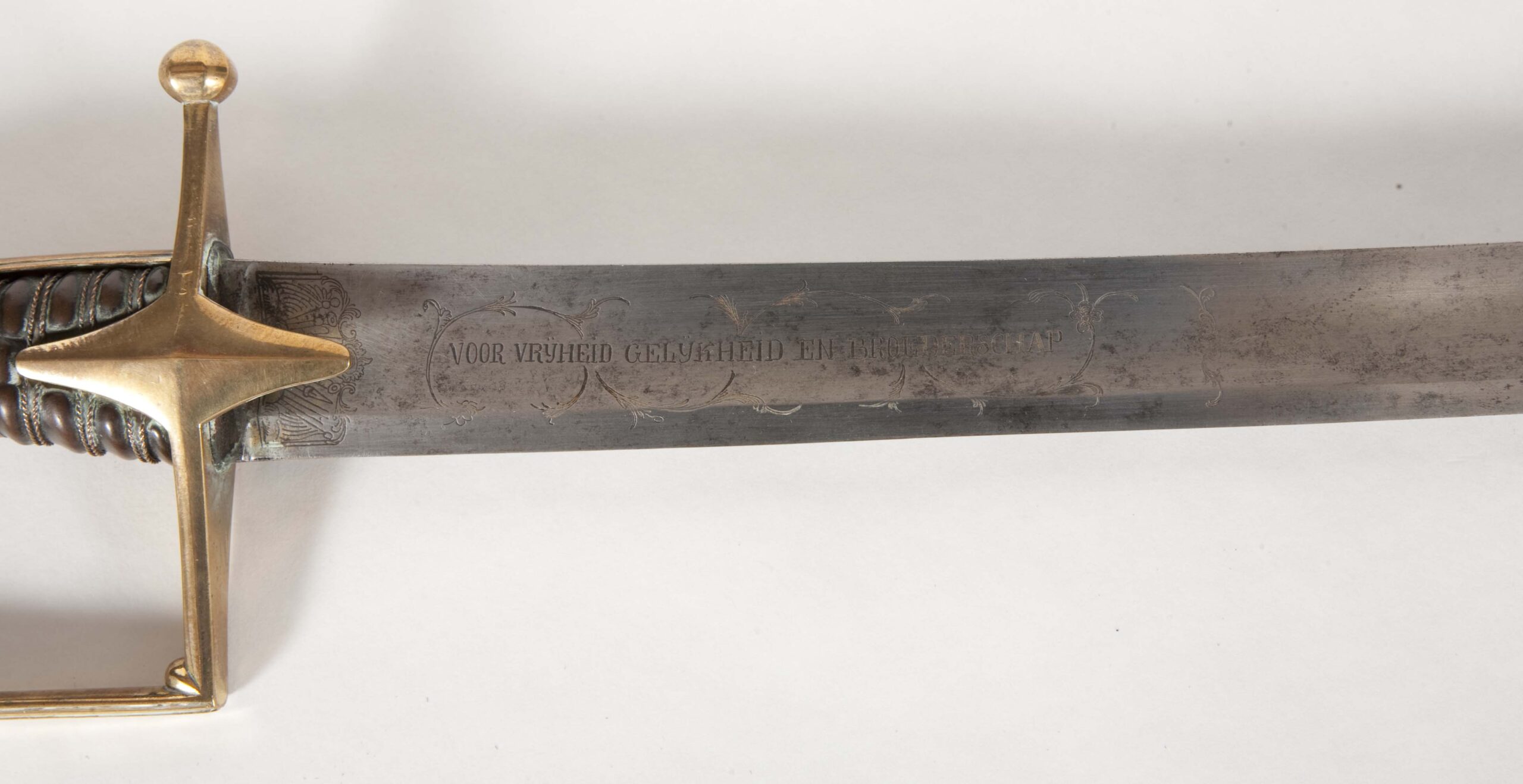
The single-edged steel blade of this fighting sabre bears on one side the unmistakably patriotic motto:
“For Liberty, Equality and Fraternity.”
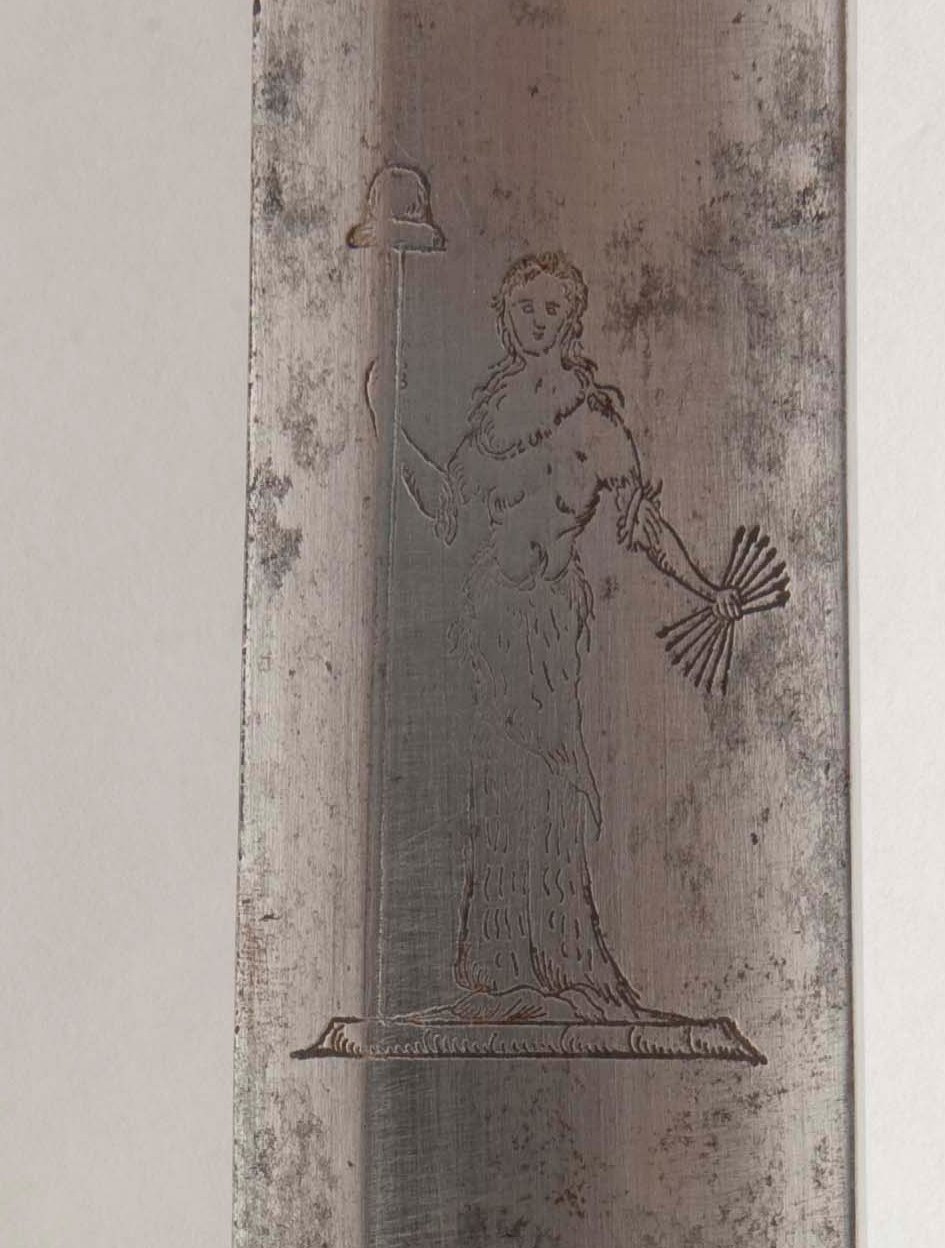
On the opposite side of the blade, in addition to a trophy of arms, there is a figure probably representing the Batavian Maiden. In her right hand she holds a bundle of seven arrows, symbolising the Republic, while in her left hand she carries a staff surmounted by a liberty cap.
The sabre is mounted with a copper knuckle-bow, a straight rear quillon with terminal button, and a long backstrap.
The knuckle-bow meets the underside of the backstrap and is secured by a tang beneath the projecting nose of the backstrap. The backstrap terminates in the pommel, where the peened end of the blade tang is visible.
The front of the knuckle-bow and the backstrap are further decorated with several engraved or moulded lines.
The wooden grip is covered in leather and bound with two twisted copper wires.
The leather scabbard is fitted with three brass mounts decorated with floral motifs. The upper and middle mounts carry thin, faceted suspension loops fitted with iron suspension rings, to which the sabre straps were attached.
The lower mount terminates in a brass drag of the same material and finish as the other scabbard mounts.
The colour of the hilt differs slightly from that of the scabbard mounts. This difference results from the manufacturing techniques and materials available at the time: hilts were generally cast, whereas scabbard fittings were formed from sheet metal. Sabels opperofficieren Bataafse…
Sabre with Helmet-Shaped Pommel and Garde Perlée
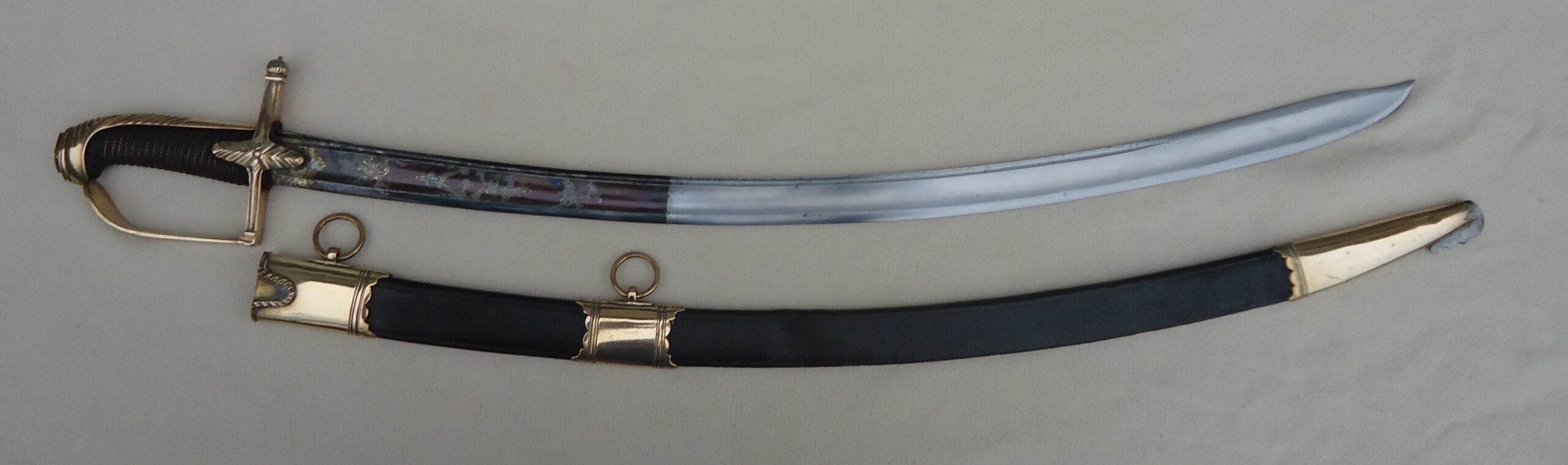
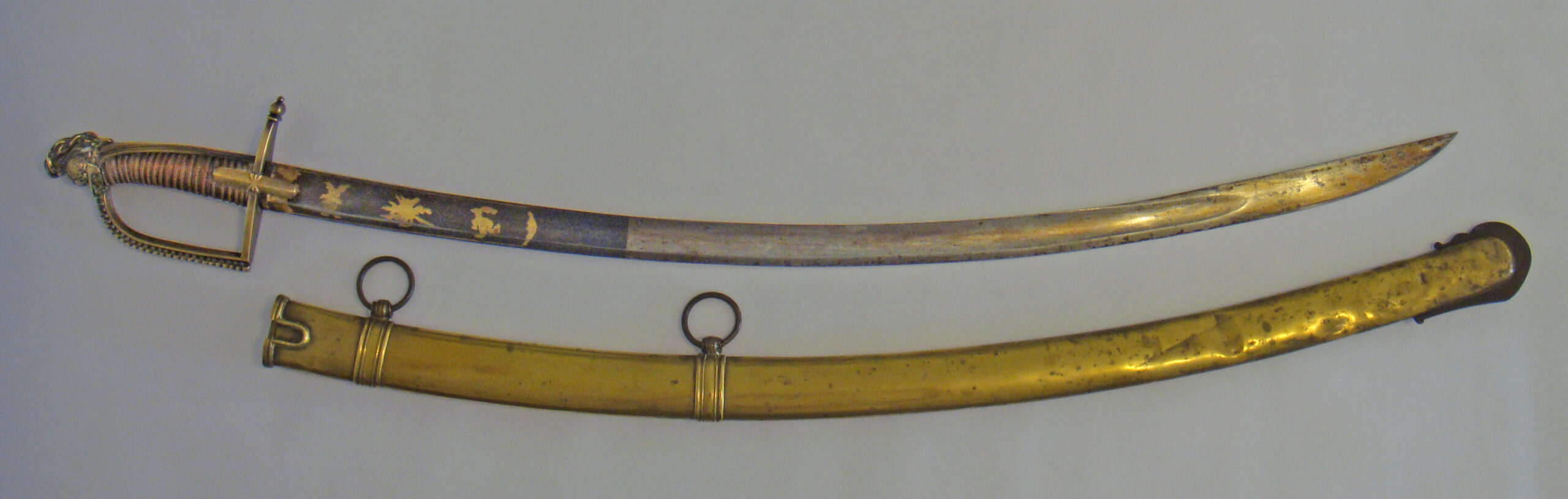
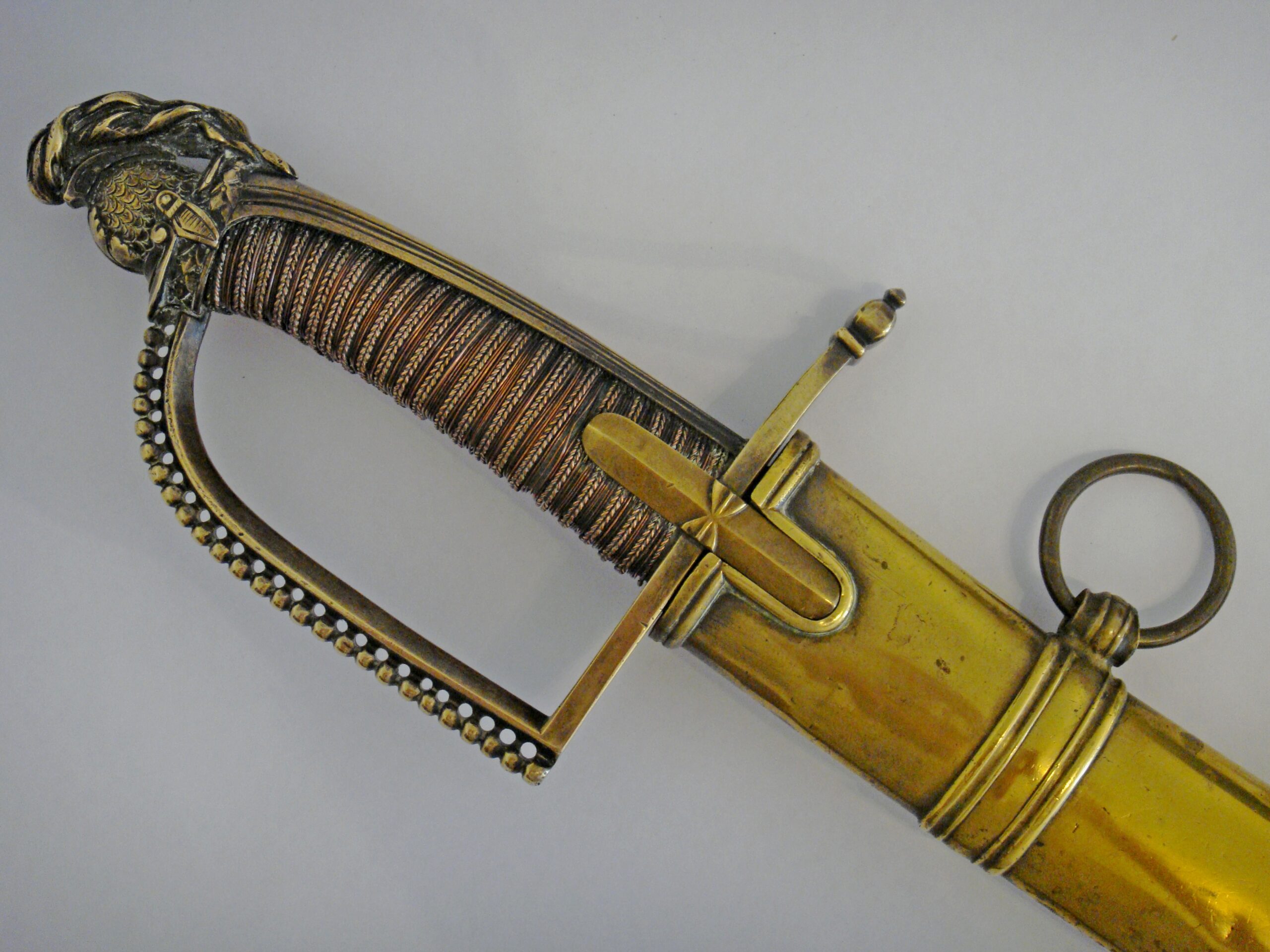
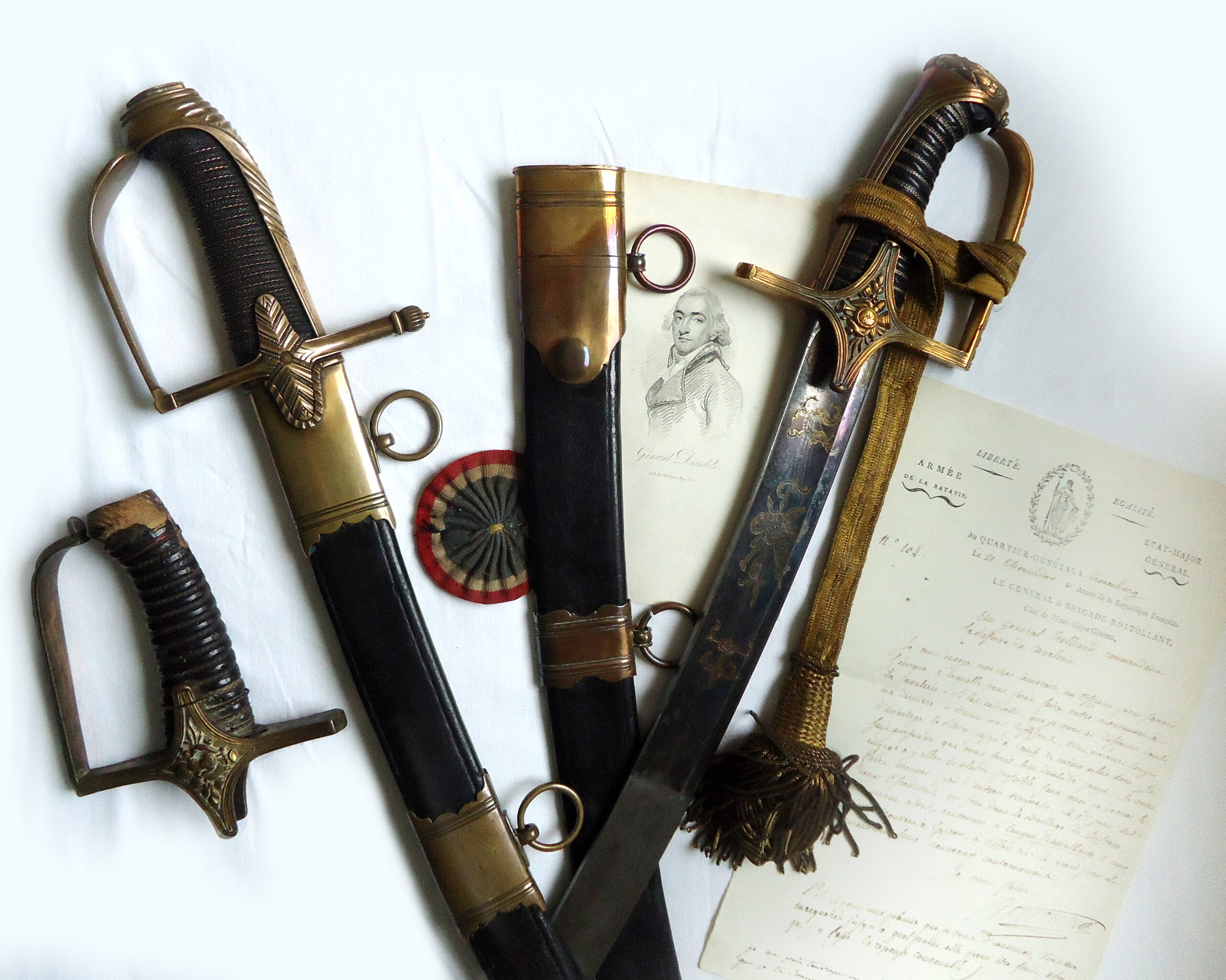
Another example can be seen in figures 7–9. With its helmet-shaped pommel, it is reminiscent of the sabres depicted in De Lelie’s painting.
This sabre existed in several variations, including examples with wooden scabbards covered in leather and fitted with copper mounts (see fig. 20). The example illustrated here is fitted with a complete brass scabbard.
The beaded hilt, reminiscent of sabres from the last quarter of the eighteenth century, is another variation found on this model. Examples with a plain knuckle-bow are also known.
This interesting sabre incorporates features which occurred throughout the period leading up to the Napoleonic Wars.
The brass knuckle-bow, fitted with a straight rear quillon, is decorated in the garde perlée style — see my previous article for a description — and meets the helmet-shaped pommel.
The rear quillon terminates in a flat, decorated finial.
The wooden grip is bound with double-twisted wire, interspersed with five smooth wires, presumably to improve grip.
The single-edged steel blade is decorated over approximately one third of its surface with floral etching, gilded against a blued ground.
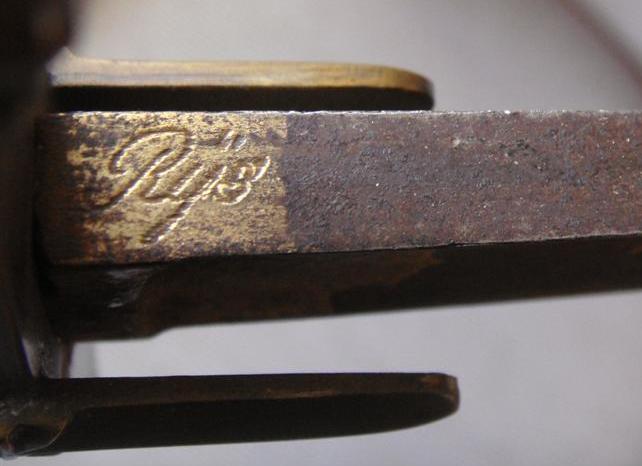
On the back of the blade, close to the hilt, the word “RIJS” is engraved. This is probably the name of the blade maker.
The spelling, particularly the Dutch “ij”, certainly appears distinctly Dutch…
The scabbard is made of brass and fitted with two large bands carrying suspension loops for the brass rings. An iron drag is fitted at the lower end.
The overall length of the sabre is 106 cm. The blade measures 85 cm, while its maximum width at the ricasso is 3.5 cm.
It is therefore a substantial sabre. Sabels opperofficieren Bataafse…
Sabre Comparable to the Daendels Example
The sabre shown in figures 10–13 shares many characteristics with the “Daendels” sabre.
Its overall length is 98 cm, with a blade length of 81 cm. This broad blade also has a curvature comparable to that of the Daendels sabre.
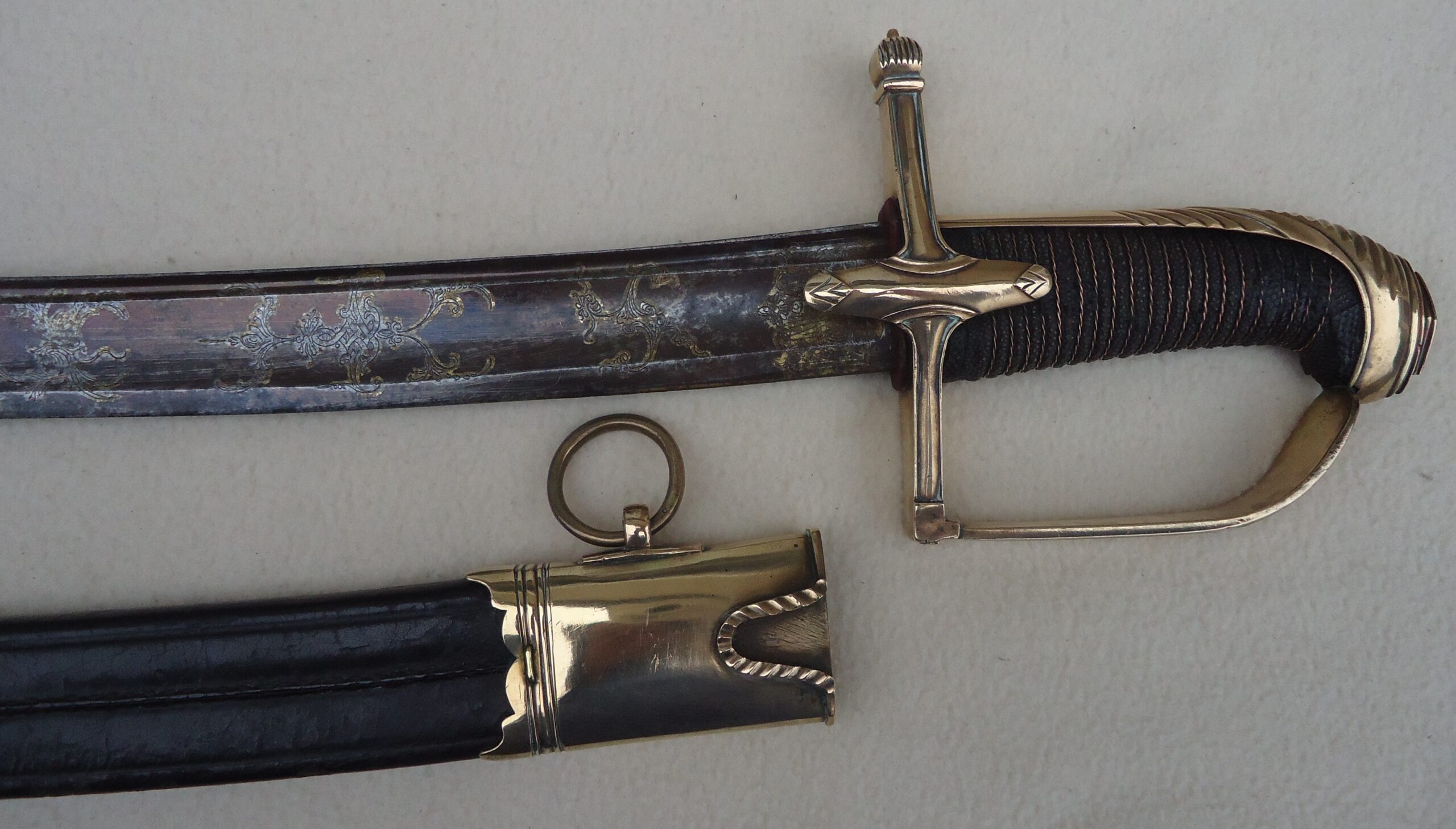
The hilt consists of a copper knuckle-bow with a straight rear quillon terminating in a decorated finial, and a long decorated backstrap extending into the pommel, on which the peened blade tang is visible.
The langets, or blade-catchers, are finely worked and carry various decorative motifs.
The grip is made of wood, covered with fishskin and bound with twisted copper wire.
The single-edged steel blade has a Montmorency fuller and terminates in a clipped or beaked point.
Approximately one third of the blade is etched, with the decoration appearing against a blued ground and highlighted with gilding.
The leather scabbard is fitted with copper mounts, with an iron drag attached to the lower fitting.
The overall quality of manufacture is particularly striking: the weapon has been assembled with great precision and represents a fine piece of craftsmanship. Sabels opperofficieren Bataafse…
Sabre with Staff-Officer Decoration
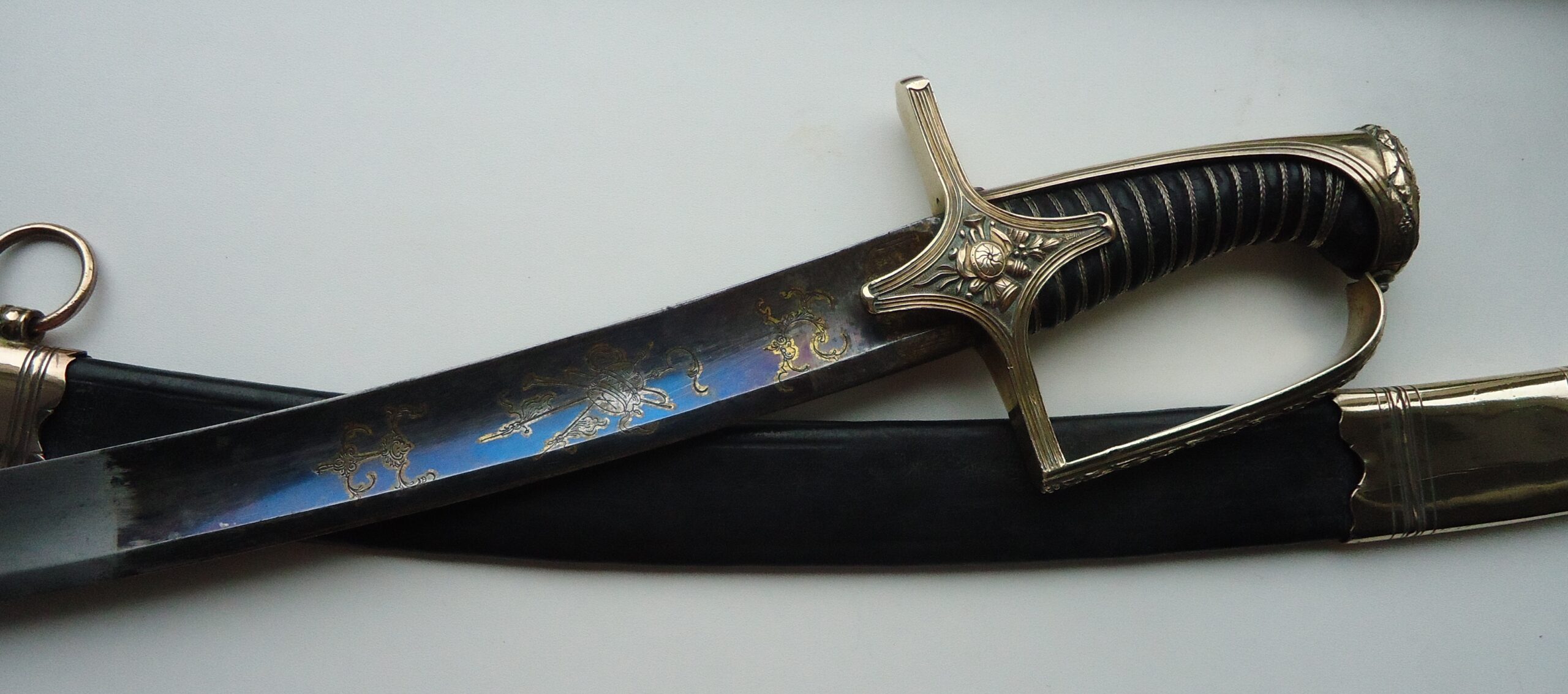
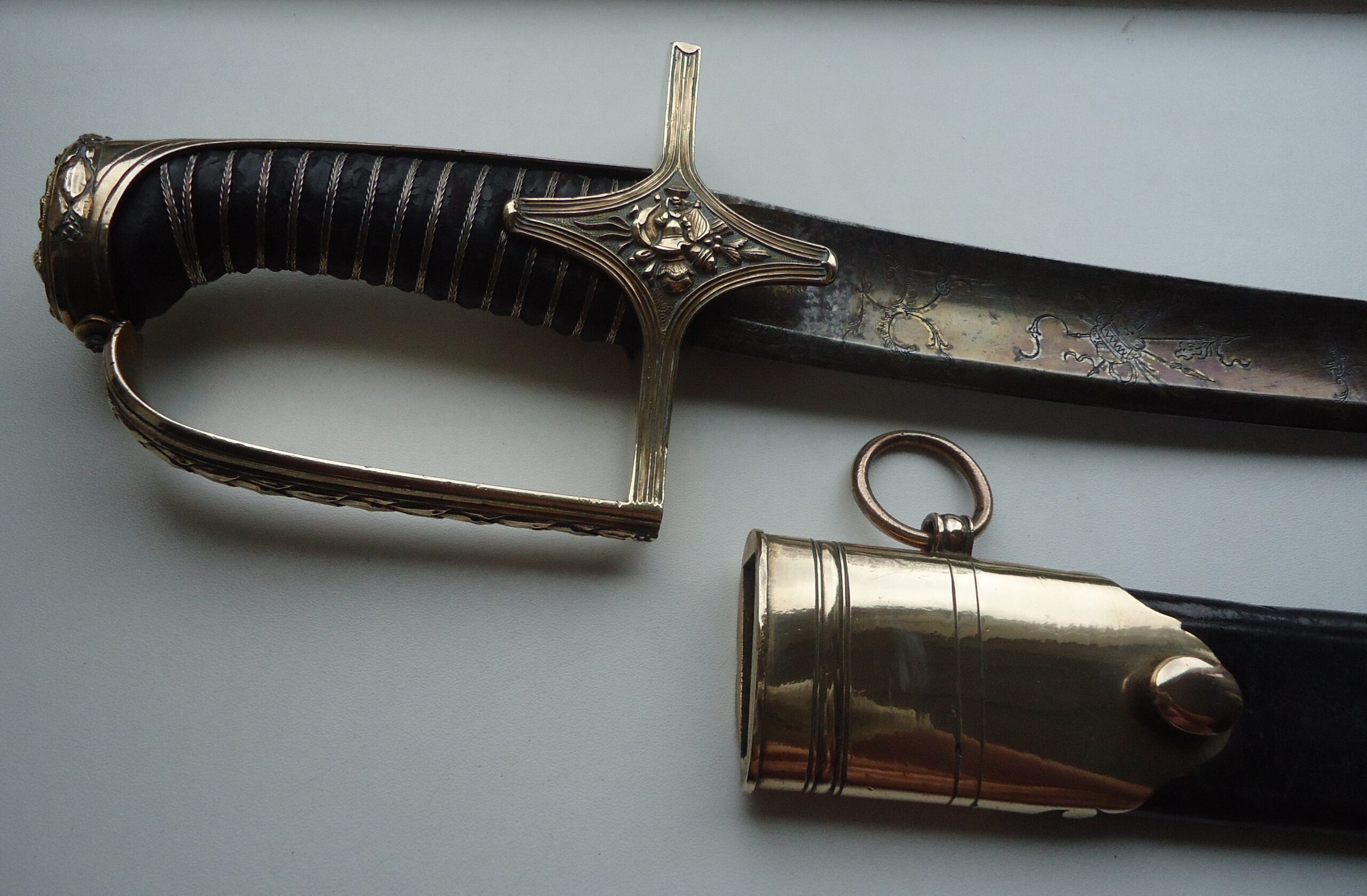
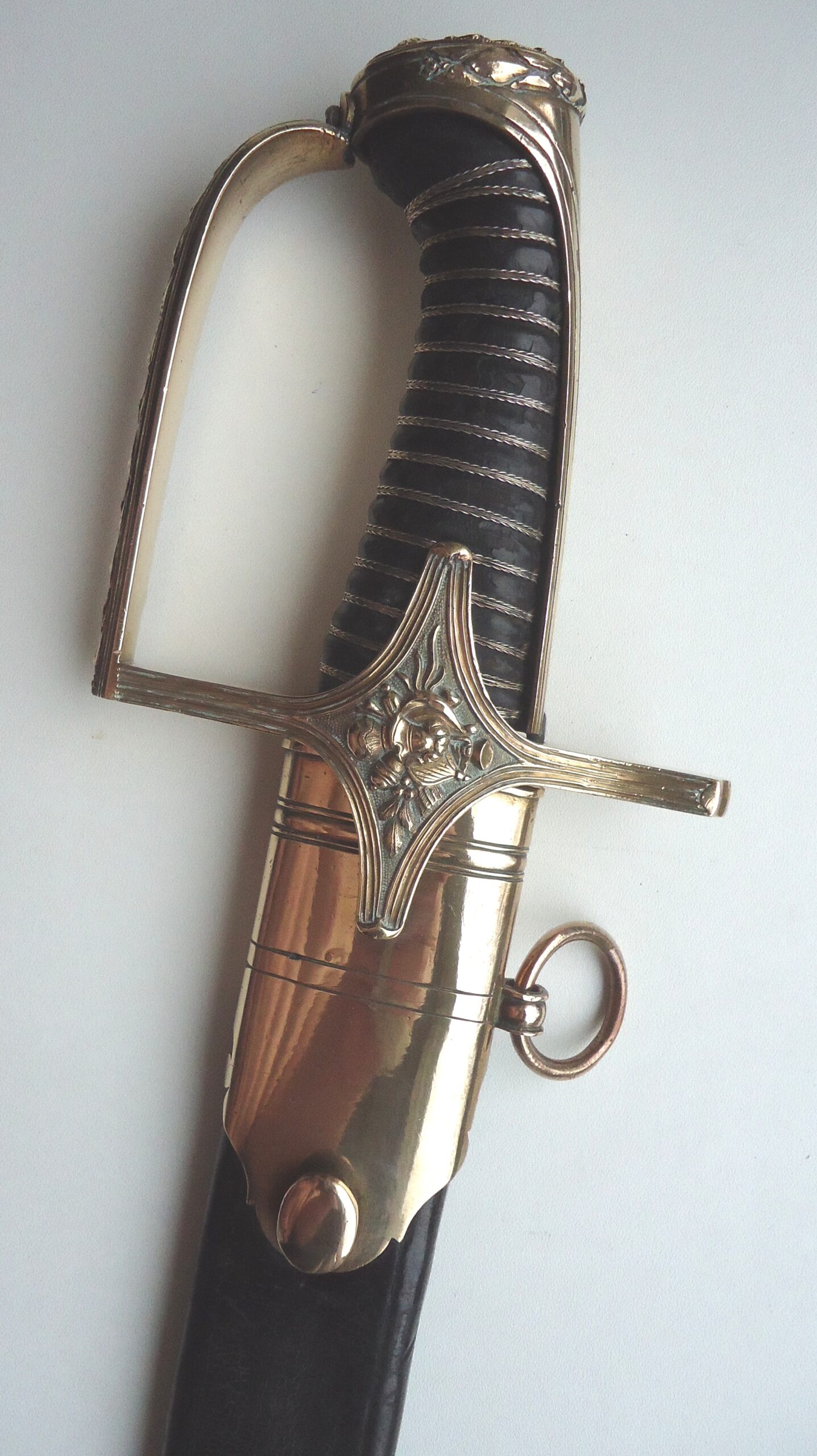
The sabre shown in figures 14–18 also displays many of the characteristics described above.
It is mounted in copper and fitted with a decorated knuckle-bow, the exterior of which bears a motif of bees with small fruits beneath them.
This type of decoration later appeared during the First Empire, although then it was used specifically on sabres carried by officers of Napoleon’s Imperial Guard.
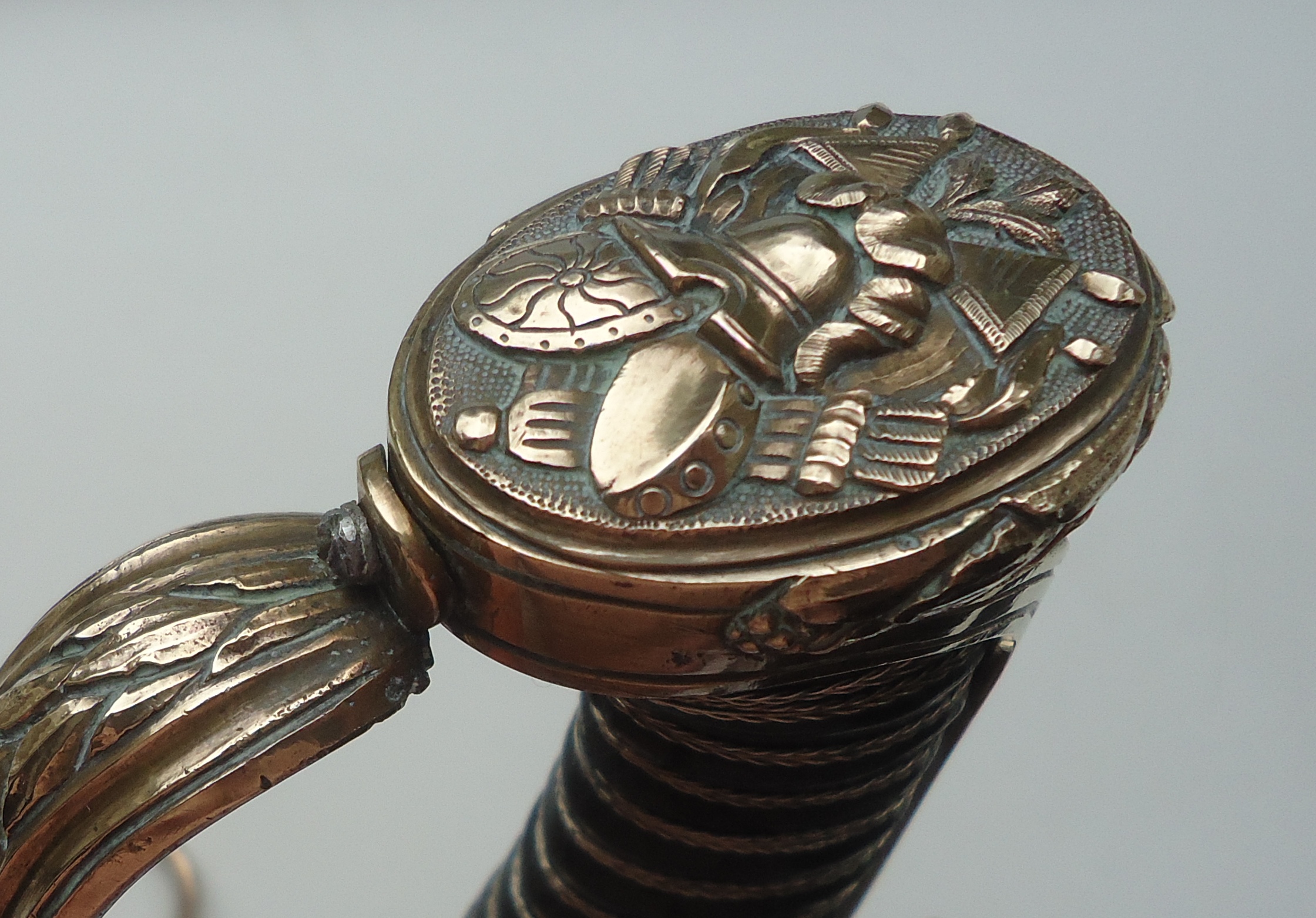
The langets and upper part of the backstrap display symbols associated with a staff officer — État-Major.
The representation of a helmet with plumes resting upon military trophies resembles the emblem frequently encountered on the sabres and swords of senior and staff officers.
This form of identification continued to appear on sabres even after the reign of Napoleon I, into the first quarter of the nineteenth century.
The version seen on this sabre appears to represent an early form of the motif which would later become more standardised.
The wooden grip is covered in black leather and bound with two twisted silver wires, between which two smooth silver wires are also visible.
At the upper end of the knuckle-bow is a small eye through which an iron screw secures the bow to the backstrap.
The broad, single-edged steel blade originates from a Solingen workshop and is etched with floral motifs alternating with trophies.
The ground is again blued, with the etched decoration highlighted in gilding.
The blade measures 84 cm, while the overall length of the sabre is 98.5 cm.
The scabbard mounts are made of copper, with an iron drag fitted to the lower mount.
The upper scabbard fitting is provided not only with the usual suspension ring for attachment to the sword belt, but also with a carrying stud, allowing the officer to raise the sabre when on foot so that it would not drag along the ground.
The middle scabbard fitting is likewise fitted with a suspension ring. Sabels opperofficieren Bataafse…
Acknowledgements and Illustrations
My special thanks go to the Voerman Museum in Hattem for allowing the use of their photographs of the “Daendels” sabre, which forms part of the museum’s core collection, and to the Van Heeckeren family for granting permission for publication concerning the sabre.
Figure 1 is a painting in the collection of the Rijksmuseum, Amsterdam.
Figure 2 is a drawing from the archives of the Army Museum in Delft.
Figure 19 is a miniature painting by François Louis Joseph Delecourt, depicting a Major of Engineers of the Batavian Republic, dated 1797. Collection: Boris Wilnitsky Fine Arts.
Figure 20: private collection P.M., Belgium. Sabels opperofficieren Bataafse…
Sources
- J.P. Puype & P. De Gryse — Viertalig lexicon van de gevestwapens
- J. Lhoste & J.J. Buigne — Armes Blanches
- J.P. Puype — Blanke Wapens, Nederlandse slag- en steekwapens sinds 1600
- Armentaria No. 23 (1988), article “Revolutionaire gevesten?” — J.P. Puype
- I. Mendels — H.W. Daendels voor zijn benoeming tot Gouverneur-Generaal van Oost-Indië, 1768–1807
- J.P. Martin — Les Armes Blanches de la Révolution
- Michel Pétard — Les sabres des Hussards
- Jean Lhoste & Patrick Resek — Les sabres
- Michel Pétard — Des sabres et des épées, tome 1 Sabels opperofficieren Bataafse…
Notes
1. General Daendels takes leave of Lieutenant-Colonel C.R.T. Krayenhoff at Maarssen (1795), by Adriaan de Lelie and Egbert van Drielst.
General Daendels takes leave of Lieutenant-Colonel C.R.T. Krayenhoff, who is being sent to Amsterdam to bring about a change in the city government, 18 January 1795. Also depicted are Colonel Van der Mühl and staff officer Jan Nagel. The scene takes place in winter, with snow on the ground. To the left, a man holding a drum is shown bending forward beside a mortar.
A manuscript dating from 1834 is attached to the reverse of the painting, explaining the scene.
2. Dr F.G. De Wilde — De uniformen van het Nederlandse leger ten tijde van de Bataafse Republiek en het Koninkrijk Holland 1795–1810.
3. Brass is an alloy of copper and zinc; by red copper I mean pure copper. Sabels opperofficieren Bataafse…
For the Red Lancer Bulletin, I would probably change only the rather dry original heading “Sabres of Senior Officers of the Batavian Republic / Early French Period” before publication; the body works well as a specialist historical article once translated.